Health has a lot to do with where we live—and how the land where we live is used. Affordable housing, parks and green space, public transit, pedestrian safety, and other resources related to land use provide the foundations of community health. These are health-supporting resources that all communities deserve.

Yet, too often, land use reinforces pervasive, historical health inequities. In many parts of the country, low-income communities of color have not received the same level of investments or innovations in healthy, equitable, and active land uses that have benefited higher income neighborhoods. Better land use decisions, such as increasing access to safe, affordable housing in all neighborhoods, are critical to reducing health inequities and rectifying racial injustices.

Prevention Institute’s work on land use and housing seeks to fundamentally shift land use planning practices so they promote safe, healthy communities where local business owners and residents have the opportunity to thrive.
Land Use & the Built Environment > Content Buckets


Prevention Institute staff shared our work and approach with practitioner audiences at conferences and webinars, including the Association of Black Foundation Executives Annual Conference, the National Association of County and City Health Officials Annual Meeting, and with the National Academies of Sciences, Engineering, and Medicine. PI also hosted a virtual teach-in, which launched PI’s new tool, The Timeline of Resistance.

Prevention Institute completed the inaugural phase of the People, Parks, and Power (P3) initiative, which brought together 14 community-rooted, power-building organizations to address deep-seated park and green space inequities in Black, Latino, and Indigenous communities across the country over two years.

In this brief, Countering the Production of Health Inequities: Ensuring the Opportunity for Health for All, Prevention Institute analyzes how various sectors such as housing, education, and economic development have contributed to inequities in health but also have important roles to play in achieving health equity. There is a role for every institution, sector, and system working together to achieve an equitable culture of health across the United States.

Learn more

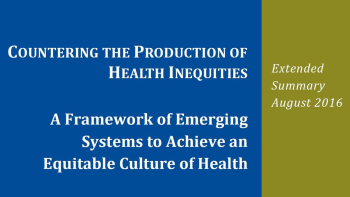
Working as a thought-partner with the Robert Wood Johnson Foundation, PI conducted an analysis to determine the sectors and systems to engage for achieving health equity, and pinpointing the actions to accomplish to achieve equitable outcomes. The analysis resulted in Countering the Production of Inequities: A Framework of Emerging Systems to Achieve an Equitable Culture of Health. The framework underscores how historical and current policies and laws, practices and procedures produce inequities in health outcomes to inform a concrete understanding of how to begin to reverse or ameliorate the inequities and support communities in transforming to achieve an equitable culture of health.

Learn more

The opportunity to be healthy is not afforded to everyone in America. As a result, many preventable illnesses occur in higher frequency, earlier, and with greater severity among people living in concentrated poverty and in communities of color. With support from the Robert Wood Johnson Foundation, Prevention Institute analyzed what has contributed to these inequities to determine a pathway forward to produce health equity.

This first-of-its-kind framework explores trauma at a community level. It explains how trauma is produced not only by experiencing interpersonal violence but also by experiencing structural violence – the harm that individuals, families, and communities experience from the economic and social structure; social institutions; and social relations of power, privilege and inequity that inhibit them from meeting their basic needs.

Learn more

Need Our Help?

We’ve got more than 25 years of experience supporting community collaboratives, practitioners, funders, and jurisdictions. Check out our services and reach out.