
People, Parks, and Power: A Learning Journey
Close your eyes. Inhale slowly and deeply, so that your stomach rises. Exhale slowly as your stomach deflates. Repeat. Then, and only when your thoughts have stopped racing, picture your community. What would it look like with greater access to parks and green spaces? What would it sound like? Smell like? Feel like? Finally, when you are ready, open your eyes.
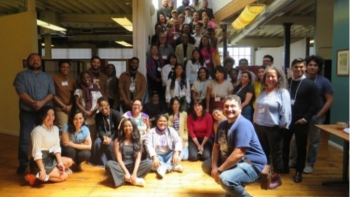
This visualization activity took place during the first People, Parks, and Power (P3) in-person Convening, an event that would cement my intuition that I was in the right place in my career. The Convening was the first time I met P3’s Local Partners (LPs), a term Prevention Institute (PI) uses in lieu of “grantee organizations” to reorient the hierarchal structure between grant-funded organizations and intermediaries or funders. There, I saw what I had never seen before, a roomful of BIPOC leaders from across the nation, all working towards park and green space equity. Their faces were aglow with passion and serenity. I was moved beyond words . . . and I was just a few months into my time at PI.
PI’s work called to me because it aligned with my experience and commitment to environmental and social justice. Before starting at PI in March 2023, I had been involved with a local environmental justice organization in Southeast Los Angeles for a few years where I focused on just, sustainable transportation and tenant protections. At that time, I already felt steeped in working at the intersection of environmental wellbeing, public health, and housing justice. However, my journey within PI’s P3 initiative would change how I view park and green space equity efforts, urban planning processes, and consultation practices.
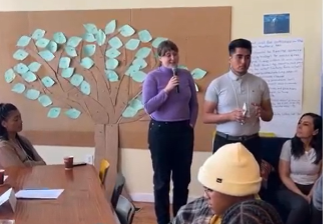
A group of people gathered in a room for a meeting or workshop. Two individuals stand at the front speaking, one holding a microphone and the other holding a small object. Behind them, a large paper tree with green paper leaves is displayed on the wall. Several people sit around a wooden table, listening attentively. There is a large sheet of paper with writing on the wall to the right.A group of people gathered in a room for a meeting or workshop. Two individuals stand at the front speaking, one holding a microphone and the other holding a small object. Behind them, a large paper tree with green paper leaves is displayed on the wall. Several people sit around a wooden table, listening attentively. There is a large sheet of paper with writing on the wall to the right.
Rethinking Parks
P3 is the first funding initiative to support community power-building with community-based organizations (CBOs) to reverse park and green space inequities in Black, Latine, and Indigenous communities. This official definition just scratches the surface of what P3 fully encompasses; in truth, LPs define and carry the work of P3 forward. Without the LPs, there would be no P3.
Who are these LPs? They are 14 BIPOC-led, women-led, and youth-led CBOs across the United States and Puerto Rico. From large cities of Los Angeles to New York, small cities of Oxnard, CA and Springfield, OH, to Puerto Rico—the LPs’ geographies are as diverse as their P3 work. The LPs’ work is intersectional: they push the definition of park & green space equity by coupling it with water equity, housing justice, labor justice, land justice, and social justice. It is a testament to how the LPs’ members bring their full selves into this work. For these leaders, it is more than work, it is their commitment to their own communities’ well-being.
The LPs also exemplify P3’s three core principles of park and green space equity, policy and systems change, and community power-building. The first principle is the fair and just distribution of parks and green spaces, such that all communities have access to these health-promoting resources. The second refers to decisions that guide and influence future actions, procedures, or resource allocations by related entities that administer, implement, or are covered by policies. The third, and ultimate, core principle includes efforts to increase the power and influence of members of underrepresented communities to set priorities and shape decision-making processes. These core principles have also influenced my other work at PI such as supporting our Health Equity and Racial Justice efforts, further developing the Timeline of Resistance tool, and within PI’s Land Use and Housing department.
Engaging the Community
Prior to working at PI, I had hoped to begin graduate school by the start of the academic year of 2024—a plan that coincided with my partner’s and our shared life goals. But after experiencing the first P3 convening, I wanted more. When I confided to my partner that I was thinking of potentially delaying graduate school, rather than pushing back, she agreed. She shared how P3 would teach me through lived realities that urban planning schools may not be able to teach in a classroom.
And she was right! P3’s focus on community power-building has shown me equitable alternatives to standard urban planning community engagement which tends to be minimal, non-existent, or transactional. This generally leads to harmful outcomes in a neighborhood, such as deciding to construct a freeway or factory in Black and brown communities. My own neighborhood of Southeast Los Angeles has been impacted by such processes and is what led me to environmental justice in the first place.
Various LPs recognize this and are fighting for increased representation of community members in decision-making bodies for parks and green spaces. On the flip side, other LPs are fighting to ensure community members are engaged at the initial planning stage of any public project, unlike typical community engagement processes occurring nearly at the end of the project. In short, LPs expound that healthy communities are only achieved through healthy democratic practices—with community at the ideation, development, and implementation of urban planning policies and practices.
My time at PI consisted of various projects, with P3 being a major one. PI itself is a national public health nonprofit that recognizes and uplifts the critical intersection of racial justice, health equity, and community power-building. I was hired onto PI without prior knowledge that I was going to be part of P3, but I was sure that PI’s expertise in various aspects of public health would land me where I best fit. This expertise influenced PI’s role in P3, though it goes beyond being a technical assistance provider: we are the facilitator and convener of the P3 initiative by serving as thought partners with our LPs and by managing our Strategic Learning Exchange (SLE) consultants.
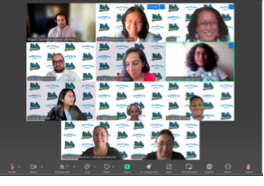
PI uses “Strategic Learning Exchange” consultants instead of “Technical Assistance” consultants because the former speaks to how we acknowledge LPs as the experts they are, whereas the latter reinforces hierarchical idea that consultants are the only experts in the field. For example, alongside our power-building SLE consultant, we have conducted Organizers Circles to nurture community power-building with LPs. These are intentional spaces where organizers and community members from the different LPs come together to share frameworks and tools, hold time for self-care during tumultuous moments, and to provide lived experiences of organizing communities. Community members show up in full force, sharing their insights despite the general tendency to respect authority only if whoever is speaking has professional degrees and several accolades. The best consultation, as I saw, is that of a learning exchange with those with lived experiences.
My focus within P3, and in this reflection piece, has centered on community power-building. Park and green space equity is critical for flourishing neighborhoods, but it is impossible to achieve without first building power in communities most affected by its absence. Impacted community members must be at decision-making tables to ideate, develop, and determine park and green spaces-related policies—full stop. I will take this lesson with me as I start the next chapter of my career in graduate school this fall.