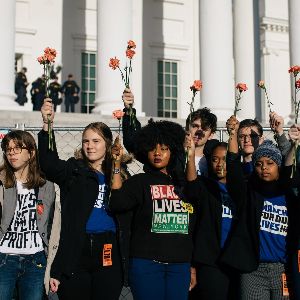
Today marks two years since the mass shooting that took the lives of 17 young people who attended Marjorie Stoneman Douglas High School in Parkland, Florida.
One of the reasons that so many people will remember that tragic and unnecessary loss of life today is because of the powerful leadership of the young people who survived the massacre. Immediately after their classmates were killed, they began to speak truth to power and demand that US policymakers be held accountable for their failure to keep young people safe from gun violence.
Their activism reinvigorated the movement to prevent gun violence and succeeded in changing state gun laws and gun sales policies at major corporations. And their movement grew bigger and more powerful when they joined forces with their peers in Baltimore, Chicago, Philadelphia, and across the country. Though federal policymakers have yet to pass legislation that restricts easy access to guns, young activists are keeping the pressure on every single day.
The power of community and youth leadership is something we’ve seen in cities we’ve collaborated with throughout the country. When community members—especially the people whose lives have been directly impacted by violence—are put in charge of coming up with solutions, amazing things happen. Community members know what their communities need to be safe and healthy, and are committed to making sure efforts to prevent violence succeed. In cities, these community members are often people of color whose neighborhoods face high levels of violence because their city leadership has failed to invest in their safety.
We hope you’ll use the resources below to learn what it looks like when community members lead. This work is made possible by the Langeloth Foundation.
Talking points: Violence Prevention Works: The Case for a Public Health Approach to Preventing Violence PI and Cities United created these talking points for people who want to make the case for a public health approach to preventing violence. A key element of taking a public health approach is putting community members in the lead to analyze the problem and develop and implement solutions.
Podcast: Community organizing to prevent violence PI’s Lisa Fujie Parks interviews Reggie Moore, Director of the Milwaukee Office of Violence Prevention and PI board member. Reggie describes how the Milwaukee Blueprint for Peace was created with leadership from communities most directly impacted by violence and why and how it addresses the structural roots of violence.
Video: East San Jose PEACE Partnership (02:30)
The East San Jose PEACE (Prevention Efforts Advance Community Equity) Partnership is a group of residents and organizations working together to build a healthy, peaceful, and empowered community in East San Jose.
* Photo credit: March for Our Lives. This photo is from the 2018 March for Our Lives protest organized by Marjorie Stoneman Douglas High School students and other young leaders.