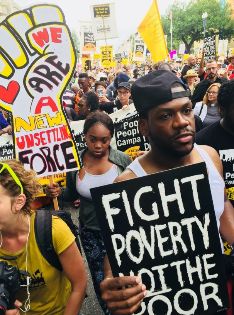
Federal proposal to redefine poverty would mean millions of people falling through the US safety net.
|
|
On May 7, the US Office of Management and Budget proposed changing how the federal poverty level is calculated. If this proposal moves forward, millions of people living in poverty will no longer fall below the official “poverty line” and thus will no longer qualify for essential programs that sustain their health like food and housing assistance. This sleight of hand—a change only on paper, rather than an actual improvement in people’s life circumstances—would fuel a health crisis of epic proportions. We do need to change the way we measure poverty—scroll down to learn more about that—but that’s because we’re currently underestimating the number of people who are struggling to meet their basic needs and underfunding social programs that support health. This proposal would move us in the wrong direction, leading to even more severe undercounts of people living in poverty and letting even more people fall through our frayed safety net. |
|
|
Act by June 14!
Learn more about this proposal from the Center on Budget and Policy Priorities and use the data points below to submit an official public comment about the harmful effect this change to the federal poverty index would have on Americans’ health. You can also email your comments to Statistical_Directives [at] omb.eop.gov (Statistical_Directives[at]omb[dot]eop[dot]gov).
|
|
|
What does poverty have to do with health?
|
|
To ensure health, safety, and wellbeing for all people, we need policies that eradicate poverty, not policies that downplay it. Poverty is one of the most significant social factors that shapes health. Here are just a few health risks associated with living in poverty:
- People with lower incomes have a shorter life expectancy than people with higher incomes. The gap in life expectancy between the richest 1% and poorest 1% of people living in the US is 15 years for men and 10 years for women.
- People living in poverty experience higher rates of heart disease, diabetes, stroke, and other chronic conditions than people with higher incomes, and face more mental health challenges like depression, anxiety, and other psychiatric disorders.
- Unintentional injuries are far more common among people with low incomes than among people with higher incomes. These injuries range from unintentional poisonings to exposure to smoke or fire to drowning.
- People living in poverty are more likely to live in overcrowded, unsafe living conditions, or experience homelessness. Overcrowded housing and high rent burdens are associated with higher rates of emergency department visits for asthma, high blood pressure, and mental health issues, and can interfere with children’s educational outcomes.
- Who lives in poverty in the US? As of 2017, 14.6% of people in the US live below the federal poverty line. That includes over 20% of all children in the US—more than 15 million kids. Native Americans, African Americans, and Latinos experience disproportionately high rates of poverty. Women and people with disabilities are also overrepresented among those who currently ‘count’ as poor.
Please take some time today or in the coming days to speak out on this issue, submit an official public comment, and share this call to action with colleagues and friends. |
|
A different way to calculate poverty
|
|
For decades, advocates have argued that the way the US government calculates the federal poverty level undercounts the number of individuals and families who cannot meet their basic human needs for food, housing, and other life-sustaining resources. This brief by the National Center for Children in Poverty explains why.
To address this deficiency, some organizations have created alternative measures of poverty, and we’d like to highlight one of them, which we featured in our brief Countering the production of health inequities: Ensuring the opportunity for health for all (see page 20).
In 2008, the United Way developed a tool to help policymakers and the public understand just how many families are financially insecure but do not fall below the official federal poverty level. The tool, ALICE, which stands for “Asset Limited, Income Constrained, Employed,” looks at the total cost of five household essentials—housing, child care, food, transportation, and healthcare—based on county-level cost of living, and also takes into account different family structures. The ALICE “threshold” more accurately calculates a household’s survival budget, helping communities develop a more complete picture of economic hardship than traditional poverty measures, and is now being used in over 400 communities across 16 states.
Many communities are using the ALICE Index data to make the case that traditional measures to calculate poverty are seriously undercounting the number of people who are struggling to get by and often are not eligible to access services that would help meet their basic needs.
Learn more about the ALICE Index here.
* Photo courtesy of the Poor People's Campaign. |
|
|