Speakers:
- Elva Yañez, Director of Health Equity, Prevention Institute
- Manal J. Aboelata, Deputy Executive Director, Prevention Institute
- Rachel Bennett, Program Manager, Prevention Institute
- Alessandro Rigolon, Assistant Professor, University of Utah, Department of City & Metropolitan Planning
On this webinar, participants will learn about how:
- Urban parks and green spaces protect public health, help mitigate the impacts of climate change, and promote environmental justice.
- African Americans, Latinos, and people who live in low-income, urban neighborhoods have less access to parks and green spaces than people who live in more affluent or predominantly white communities.[i]
- To address green space inequities, we need to change the policies and systems that created such inequities.
- Power drives policy and systems change. Investing in community power building is key to achieving green space equity.
- Promising policies to advance park and green space equity are being adopted in jurisdictions across the U.S.
- Prevention Institute is collaborating with the Robert Wood Johnson Foundation to plan a new national funding initiative for park and green space equity.
Support for this work was provided by the Robert Wood Johnson Foundation.
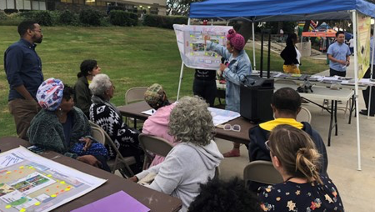
*Photo credit: Kounkuey Design Initiative
[i] Rigolon, A. (2016). A complex landscape of inequity in access to urban parks: A literature review. Landscape and Urban Planning, 153, 160-169.
|