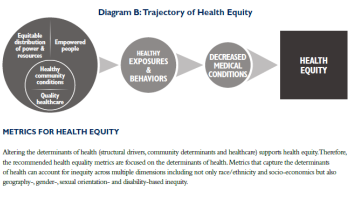
This report offers research, analysis, frameworks, and practitioner wisdom to understand the factors in the community environment that support safe relationships and a reduction in domestic violence (DV). It identifies opportunities for 13 sectors to engage in DV prevention, and offers a method for multiple sectors to identify joint strengths, strategies, and outcomes. The paper presents an overarching approach to advancing a health equity and multisector approach to DV prevention, and identifies broad elements and immediate next steps to move this approach forward.
This first-of-its-kind framework explores trauma at a community level. It explains how trauma is produced not only by experiencing interpersonal violence but also by experiencing structural violence – the harm that individuals, families, and communities experience from the economic and social structure; social institutions; and social relations of power, privilege and inequity that inhibit them from meeting their basic needs.
This paper provides a framework for understanding how disparities in health outcomes are produced and how health equity can be achieved, particularly by addressing the determinants of health. It also delineates a set of metrics that could reflect progress toward achieving health equity.
Chapter in the text book "The New World of Health Promotion: New Program Development, Implementation, and Evaluation," presents a detailed framework for strategically applying prevention to reduce health and safety inequities.
Need Our Help?
We’ve got more than 25 years of experience supporting community collaboratives, practitioners, funders, and jurisdictions. Check out our services and reach out.