
What Leaving My Hometown Taught Me About Narrative Change
I currently call Houston my home, but I was born in El Paso, TX, a mountain city tucked between the Texas and New Mexico border. The city touts amazing landscapes, with the deep purple Franklin Mountains and stunning sunsets, a rich admiration for arts, faith, and culture, and quirky historical facts like alligators roaming around Downtown (really!). I’ve grown to have so much reverence and pride for my city, the resilient and kind nature of El Pasoans leaving a lasting impact on the way I approach my work in public health.
After leaving my hometown, I quickly learned about a different perspective: the prevailing notion that cities on the border of Mexico are dangerous hotbeds of criminal activity. These assumptions caught me off guard. I knew it wasn’t true, in fact, El Paso has been described as one of the safest large cities in the United States for years. Reflecting on this dichotomy, I realized these and other popular narratives act as veils, influencing the way we interact with, think about, and speak to each other. As I entered my career in public health, this experience motivated me to think differently about how the narratives we choose to focus on can negatively impact communities.
As a public health practitioner who focuses on equitable data collection and analysis, I often use context, experiences, and stories as evidence to inform strategy development and decision-making.
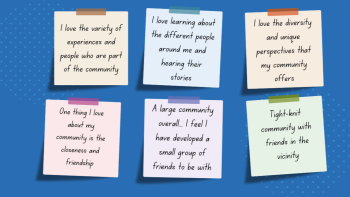
In 2023, Prevention Institute held advocacy workshops with high-school aged youth leaders across Texas to provide a platform for them to advocate for community change. When we first started to get to know each other, instead of asking what was wrong in their communities, we asked what they loved. Regardless of where they were from, all of the youth leaders’ answers described tight-knit, trusting communities and valuable relationships that kept them going during hard times. These stories set our workshops up to center those valued relationships, using them as an avenue to advocate for affirmative policies in their schools that promote trusting relationships between educators, administrators, and students.
By starting out talking about lived experiences and assets, instead of data about deficits and problems, we’re able to build tailored strategies that lift up what community members value the most.
How can the field of public health harness rich stories and experiences as data to push back against prevailing, prejudicial narratives?
Be Curious About What’s Already Working
In a quickly changing public health environment, we are prone to focusing too deeply on what is lacking or what needs to be fixed. While it is important to identify what needs to be worked on, there's another step that’s often missed - leveraging what is abundant and successful in communities. Through our Communities of Care Initiative, we worked with collaboratives across 10 diverse communities in the Houston area to address root causes that impact youth mental health. Each community approached the topic of mental health differently based on their cultural practices, level of community trust, or personal definitions of mental health. For some, this meant leaning on residents’ relationship with faith-based institutions to provide spaces for connection, while others found success in using local outdoor spaces for recreation, education, and mindfulness.
While every collaborative’s strategies and messaging looked different, they all centered the unique community assets that residents relied on for their wellbeing. Being curious about the things that have worked, why they work, and how they’re sustained by residents can shine a light on aspects of communities that are often never measured or considered through standard data collection practices.
Practice Environmental Storytelling
When gathering qualitative data, we often rely on interviews and focus groups, gathering verbal accounts of what people think and feel. A concept often used in video game design, environmental storytelling can reveal deeper stories and histories that aren’t easily articulated through words. Techniques like photovoice or graphic recording can be used to describe elements like culture, history, and community that may be hard to put into words.
During training sessions with local partners on health equity, we often share images of real, under-resourced communities around Houston and ask participants to describe how equity has shaped these environments. In past training sessions, people who were familiar with the community we showed focused on evidence of community members caring for each other, like fixed signage or patched up homes, instead of other features that are more obvious to others, like aging buildings or lack of infrastructure. The conversation became much richer when we were able to talk about signs of resilience, often revealing a deeper narrative and truth about the community we were observing that we wouldn’t have gotten without the firsthand experience from training participants.

Use the Same Language
Public health researchers often use coding to analyze qualitative data, requiring them to make decisions about how to summarize and chunk similar ideas from many different sources. The themes we identify and connect can be much richer if we maintain the same language that the communities we work with use. While it’s easy to slip back into jargon, using terms that community members are familiar with and recognize can lead to greater sensemaking when data is presented back to them.
For example, talking to Houstonians about their perspective of “The Inner Loop” can elicit very different responses compared to the formal name, I-610. While the road itself doesn’t carry much significance, the term “The Inner Loop” comes with the context of resident displacement, highway expansion, and gentrification. Because the terms we use can carry heavy context and history, we must maintain the language of the communities we work with to obtain findings that are meaningful, long-lasting, and impactful.
When we practice centering peoples’ lived experiences, culture, and histories the same way we rely on Census data and statistical figures, we’re able to see communities as they see themselves, providing rich opportunities to co-create solutions.
Think about where you grew up, your favorite spot in town that everyone knows about, the mentors you relied on, or the shared histories that shaped your community. Now, imagine trying to describe your community without mentioning any of those things. Experiences, history, and stories are an inextricable aspect of what makes our communities feel like home, and it’s important to keep this in mind when we walk into someone else’s home and try to 'fix' it.
In a time of misinformation and harmful rhetoric, it’s up to public health to find innovative ways to engage with stories and experiences as evidence to promote narrative change that uplifts all parts of communities, especially those that are loved the most.
Later this year, Prevention Institute will release an action guide for practitioners to apply contextual and experiential evidence to create evidence-rich narratives that can support equitable policy and structural change. This framework will provide a guide to:
- Identifying relevant and accessible contextual and experiential evidence;
- Understanding bias within data sets and selecting indicators in light of their limitations;
- Incorporating contextual and experiential data to share stories that connect evidence to structural, community-driven solutions that advance affirmative narratives; and
- Weaving multiple forms of evidence into a narrative strategy.
This blogpost is the second blog in a series on Braiding Evidence for Equity & Impact. Check out the first blogpost in this series, From Numbers to Narratives: Weaving Data, Context, and Experience to Drive Equitable Systems Change.
This post was authored by Kalia Pannell, MPH, Community Impact and Engagement Specialist. Stay connected with our body of work—you can follow us here on LinkedIn, sign up for the Prevention Institute newsletter, or reach out directly to Kalia (kalia [at] preventioninstitute.org (kalia[at]preventioninstitute[dot]org)).