
Aligning systems, narratives, and investments to advance a public health ecosystem grounded in health equity and racial justice

Health equity means that everyone has a fair and just opportunity to attain their full health potential and that no one is disadvantaged, excluded, or dismissed from achieving this potential. At Prevention Institute, we focus on how structural drivers of inequity—such as racism, sexism, and income inequality—impact communities. And we support community-based organizations and advocates in building power and capacity to change the systems that created these inequities in the first place.
Racial justice is a primary focus of Prevention Institute’s health equity work because racism, discrimination, and other forms of racial injustice have resulted in dramatic health and safety disparities for communities of color. Without closing racially unjust gaps in health outcomes, we will not be able to achieve health, safety, and wellbeing for our nation as a whole.
Our work is implemented through partnerships and collaborations with coalitions, public health departments, and community-based organizations; and centers the lived experiences of communities whose voices have been historically excluded and underrepresented. We bring our tools and frameworks to inform and build capacity toward effective prevention, racial justice, and health equity strategy development. Our staff are our champions who bring both professional and personal experience to the table and help shape equity solutions that support community health, safety, and wellbeing

Aligning systems, narratives, and investments to advance a public health ecosystem grounded in health equity and racial justice

This new brief describes four shifts in the urban planning sector to advance equity and racial justice, steer decisions more directly toward communities’ benefit, respect grassroots power to drive solutions, and root out pay-to-play influence in the land use system. While this brief was written with insights from the Los Angeles context, the overall principles are applicable to any community working to address inequities in land use and the built environment.
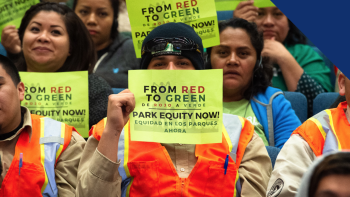
This policy brief reviews evidence of park inequities in the Los Angeles region, lays out a framework for achieving park equity, and sets forth policy recommendations.

This concept paper explores how and why to bring together people working on health equity and racial justice, including understanding the tensions between these two approaches, recognizing shared goals, and identifying five strategic opportunities for collaboration. Contact La'Quana Williams for more information.

In this brief, Countering the Production of Health Inequities: Ensuring the Opportunity for Health for All, Prevention Institute analyzes how various sectors such as housing, education, and economic development have contributed to inequities in health but also have important roles to play in achieving health equity. There is a role for every institution, sector, and system working together to achieve an equitable culture of health across the United States.

We advance racial justice practice and outcomes by making them actionable. Bridging health equity and racial justice recognizes that health, safety, and wellbeing depend on racial justice.

In Healthy Development without Displacement: Realizing the Vision of Healthy Communities for All, we explore: What can people working on “healthy community” issues—like active transportation, parks, healthy food, planning, public health, healthcare, and more—do in their own work to improve community conditions without contributing to gentrification and displacement?

This report offers research, analysis, frameworks, and practitioner wisdom to understand the factors in the community environment that support safe relationships and a reduction in domestic violence (DV). It identifies opportunities for 13 sectors to engage in DV prevention, and offers a method for multiple sectors to identify joint strengths, strategies, and outcomes. The paper presents an overarching approach to advancing a health equity and multisector approach to DV prevention, and identifies broad elements and immediate next steps to move this approach forward.

Welcome to module 7, Good Health Counts: Measurement and Evaluation for Health Equity. Here you will learn about community health indicators and how they can be used to assess and monitor conditions that influence health and safety. We will highlight a number of indicator reports that have been used to advance health equity efforts.
Welcome to Module 6, The Importance of Local Policy for Achieving Equitable Outcomes. In this module, we will look at why policy--at the city and county levels, in particular—is important to health equity efforts. Then, we will provide an overview of 4 key strategies in the policy development process.
We’ve got more than 25 years of experience supporting community collaboratives, practitioners, funders, and jurisdictions. Check out our services and reach out.