
In this module, we will describe The Spectrum of Prevention framework and explore how it can be used to Address Health Equity

Health equity means that everyone has a fair and just opportunity to attain their full health potential and that no one is disadvantaged, excluded, or dismissed from achieving this potential. At Prevention Institute, we focus on how structural drivers of inequity—such as racism, sexism, and income inequality—impact communities. And we support community-based organizations and advocates in building power and capacity to change the systems that created these inequities in the first place.
Racial justice is a primary focus of Prevention Institute’s health equity work because racism, discrimination, and other forms of racial injustice have resulted in dramatic health and safety disparities for communities of color. Without closing racially unjust gaps in health outcomes, we will not be able to achieve health, safety, and wellbeing for our nation as a whole.
Our work is implemented through partnerships and collaborations with coalitions, public health departments, and community-based organizations; and centers the lived experiences of communities whose voices have been historically excluded and underrepresented. We bring our tools and frameworks to inform and build capacity toward effective prevention, racial justice, and health equity strategy development. Our staff are our champions who bring both professional and personal experience to the table and help shape equity solutions that support community health, safety, and wellbeing

In this module, we will describe The Spectrum of Prevention framework and explore how it can be used to Address Health Equity
Working as a thought-partner with the Robert Wood Johnson Foundation, PI conducted an analysis to determine the sectors and systems to engage for achieving health equity, and pinpointing the actions to accomplish to achieve equitable outcomes. The analysis resulted in Countering the Production of Inequities: A Framework of Emerging Systems to Achieve an Equitable Culture of Health. The framework underscores how historical and current policies and laws, practices and procedures produce inequities in health outcomes to inform a concrete understanding of how to begin to reverse or ameliorate the inequities and support communities in transforming to achieve an equitable culture of health.
THRIVE was created to answer the question, what can communities do to improve health and safety and promote health equity? THRIVE is a framework for understanding how structural drivers play out at the community level to impact the social-cultural, physical/built, and economic/ educational environments - i.e. the community determinants of health - and consequently, health and safety outcomes, and inequities in outcomes. THRIVE is also a tool for engaging community members and practitioners in assessing the status of community determinants, prioritizing them, and taking action to change them to
The opportunity to be healthy is not afforded to everyone in America. As a result, many preventable illnesses occur in higher frequency, earlier, and with greater severity among people living in concentrated poverty and in communities of color. With support from the Robert Wood Johnson Foundation, Prevention Institute analyzed what has contributed to these inequities to determine a pathway forward to produce health equity.

This first-of-its-kind framework explores trauma at a community level. It explains how trauma is produced not only by experiencing interpersonal violence but also by experiencing structural violence – the harm that individuals, families, and communities experience from the economic and social structure; social institutions; and social relations of power, privilege and inequity that inhibit them from meeting their basic needs.
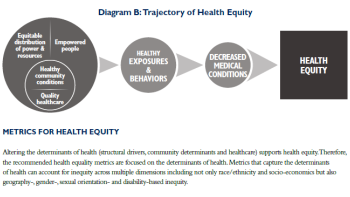
This paper provides a framework for understanding how disparities in health outcomes are produced and how health equity can be achieved, particularly by addressing the determinants of health. It also delineates a set of metrics that could reflect progress toward achieving health equity.

Decisions about how land is used, by whom, and for what purposes hold immense potential to prevent violence before it occurs, but land use decisions are rarely made with violence prevention in mind. This publication offers recommendations for creating safer communities through a deeper understanding of the intersection of place and safety.

This Centers for Disease Control and Prevention guide, developed with help from Prevention Institute, helps public health practitioners advance health equity through community prevention strategies.

Across the country, healthy food and activity leaders have identified violence and the fear of violence as major roadblocks to the success of chronic disease prevention strategies. This PI report provides an explanation of the inter-relationship between violence and healthy eating and activity.
Our free, interactive online primer helps practitioners build primary prevention and equity into community health.
We’ve got more than 25 years of experience supporting community collaboratives, practitioners, funders, and jurisdictions. Check out our services and reach out.