

Developing a Message
Developing a Message
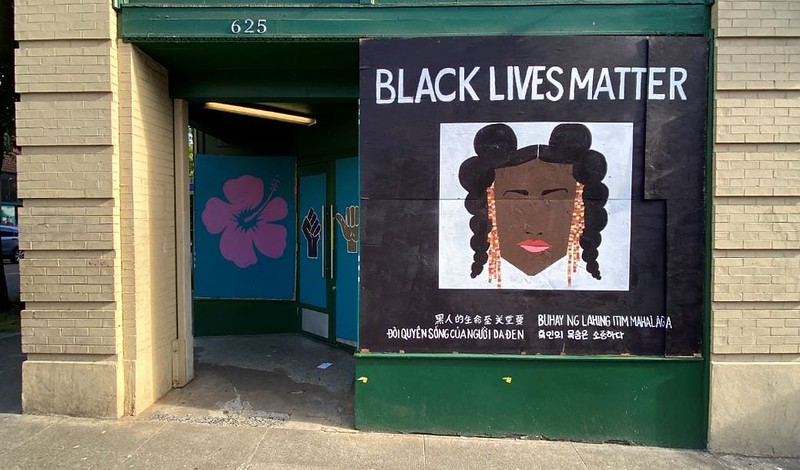
Image credit: Seattle Department of Transportation on flickr; image by Casey Rogers
What we communicate and the words and images we use are important. This includes making sure we have the right messengers (see next section, Connecting Policy and Systems Change with Narrative Change, for more on Centering and Elevating the Voices of Those Most Impacted by Violence), as well as deciding on the language to use, and the appropriate framing. Some suggestions include:
- Allow community members most impacted to define what safety means to them. Each community will have different strengths, assets, needs, challenges, and desires. It is important for community organizations and residents to engage in dialogue to decide what safety means, along with their priorities and strategies.
- Focus on asset-based framing. All communities have strengths, assets, and possibility, and it’s important to focus on this rather than solely on deficits and pitfalls. To counteract the negative stories about communities experiencing high rates of violence, we need to uplift stories of hope and resilience that illustrate community strengths, their progress, and how they are thriving. This should include humanizing residents rather than mentioning them abstractly or as numbers and statistics.
- Use language to positively shape perception of communities and community members. Language is important in elevating community-centered narratives that advance community safety. It’s important that we use this opportunity to examine our language to avoid pathologizing people of color as inherently violent[1] or elevating whiteness as inherently virtuous.[2] For example, using the word “violence” in the name of an organization or program that serves communities most impacted by violence may influence the way those utilizing those services are perceived by others.
- Use collectively agreed upon terms, definitions, and language when communicating about safety and violence. Conversations with stakeholders engaged in safety and violence prevention work across the U.S. has highlighted the importance of a community coming to agreement on common terms, definitions, and language to talk about safety and violence. This helps maintain consistent messaging with multiple partners including community members, decision-makers, and media, and has been instrumental in key successes. It is necessary that community members be involved in the development of this common language.
- Prioritize the concerns of community members most impacted by violence. Highlight community-defined drivers of community safety that may not be reflected in quantitative data, or may be undervalued as idiosyncratic, political, or anecdotal. Community members impacted by violence whom we have interviewed recognize that economic inequities (e.g., inequitable access to jobs and a living wage) and a justice system that at times over-criminalizes communities of color and at other times under-polices and fails to protect them are drivers for violence in their communities. These two issues are often intertwined and contribute to high rates of violence and trauma.[3] Notably, economic inequities and unjust law enforcement approaches have been exacerbated since the onset of the COVID 19 pandemic in early 2020.[4] Community safety efforts require long-term investments that include improving the physical environment, strengthening connections and relationships, and addressing economic inequities. Connecting these dots while leading with a conversation on racial inequities will help develop effective messages.
- Finally, it is important that your communications are explicit about solutions. While we cannot tell you what those solutions are, the preceding tips can provide guidance on how to communicate but not what to communicate. The specific solutions that organizations working on community safety choose may vary depending on the messenger, context, and audience. Regardless of their form, solutions should always be part of the message.
Note: The preceding information was adapted from research conducted by prevention Institute for the Annie E. Casey Foundation in 2022, and which formed the bases for a joint publication developed with FrameWorks Institute, Framing Community Safety: Guidance for Effective Communication.
[1] Duxbury, S. W., Frizzell, L. C., & Lindsay, S. L. (2018). Mental illness, the media, and the moral politics of mass violence: The role of race in mass shootings coverage. Journal of research in crime and delinquency, 55(6), 766-797. Accessed at https://journals.sagepub.com/doi/pdf/10.1177/0022427818787225?casa_token=q121loVSRNgAAAAA:g4EMtyJZJXaEokPd8yd4eWoEaq0rjXy0We5jzj4Th8_9_mgzXSzVGQauVLgIB5Hp4utIxAWVAj5g
[2] Lane, K., Williams, Y., Hunt, A. N., & Paulk, A. (2020). The framing of race: Trayvon Martin and the Black Lives Matter movement. Journal of Black Studies, 51(8), 790-812. Accessed at https://journals.sagepub.com/doi/pdf/10.1177/0021934720946802?casa_token=T13HiGaozKcAAAAA:esbOdXfmeVB0aPHvvPtGpF7cha5WmFsTSa7Dkfr1hgfSQd762yfYcFUNJmERH5I16K0sg9kPWWe0
[3] David-Ferdon, C., Vivolo-Kantor, A. M., Dahlberg, L. L., Marshall, K. J., Rainford, N. & Hall, J. E. (2016). Youth Violence Prevention Resource for Action: A Compilation of the Best Available Evidence. Atlanta, GA: National Center for Injury Prevention and Control, Centers for Disease Control and Prevention.
[4] Vasquez Reyes M. The Disproportional Impact of COVID-19 on African Americans. Health Hum Rights. 2020 Dec;22(2):299-307. PMID: 33390715; PMCID: PMC7762908.